
Papakoso is a family-support brand built on the belief that
“Fathering brings smiles to families.”
We encourage parenting and household roles that are not defined by gender,
and support families in sharing the work of raising children.
Supporting fathers in childcare contributes to the wellbeing of the family.
When parents share both the challenges and joys of raising a child,
it creates moments that lead to more smiles at home.

STORY
From fathers’ parenting to family smiles.
Papakoso — a dad-focused parenting brand born from the experience of a rare illness affecting one in 100,000.
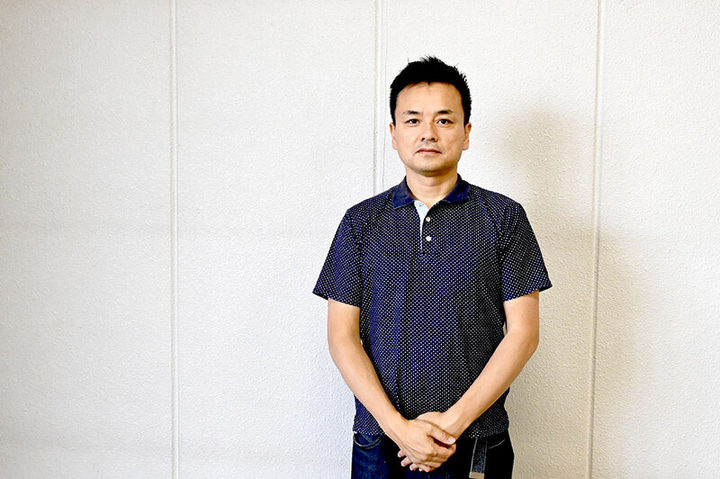
(株式会社ワンスレッド代表取締役 半田真哉)
Since its founding in 2010, One Thread Co., Ltd. has worked primarily with Japanese production regions, planning textile products such as knitwear and cut-and-sewn items with a focus on materials.
A turning point came in the seventh year of the company — the start of Papakoso, a parenting support brand.
Papakoso is currently the only parenting goods brand in Japan designed specifically for fathers.
Why “for fathers”?
CEO Shinya Handa shares the story behind the brand.
Smiles for families through fathers’ parenting.
Papakoso’s motto is:
“Smiles for families through fathers’ parenting.”
The name Papakoso comes from the phrases “papa’s parenting” and “papa as a parent.”
However, Papakoso is not a brand made only for fathers.
By beginning with “fathers’ parenting,” we aim to strengthen partnership between parents and create products and services that bring more smiles to families.
The first Papakoso product, the “Papa Bag — designed with 140 fathers and mothers,” received the 12th Kids Design Award in 2018.
The second product, the “Papa-Dakko” baby carrier designed for fathers, received the Kids Design Association Chairman’s Award at the 13th Kids Design Award in 2019.
In 2020, the Papa Bag received the 1st Japan Child-Rearing Support Award.

We develop father-focused parenting goods that are not found in the market, and are working to grow as the only parenting goods brand in Japan designed specifically for fathers.
Why “for fathers” now?

In Japan, the number of dual-income households surpassed that of single-income households in 1997.
By 2020, dual-income households had reached 12.45 million — more than twice the number of households with a stay-at-home spouse.
As more couples work and raise children together, family structures have become increasingly diverse.
However, the term “ikumen,” which refers to fathers who actively participate in childcare, is still widely used in Japan — indicating that men’s involvement in household and childcare duties is not yet taken as a given.
The story began with a rare illness affecting one in 100,000.

My journey into parenting began with my wife’s illness.
We have two children, but during her pregnancy with our first son, an unexpected illness was discovered — a rare brain tumor (acoustic neuroma) that affects only one in 100,000 people.
Before the tumor was found, my wife was diagnosed with threatened premature labor at 29 weeks and was hospitalized.
She was placed on strict bed rest, receiving medication around the clock to prevent contractions, with the goal of reaching 35 weeks.
However, just before reaching that milestone at 34 weeks, her condition suddenly changed.
Her hearing in her right ear declined, tinnitus intensified, and she began to feel coldness in the right side of her mouth and had difficulty tasting.
Soon, facial paralysis appeared, and she was unable to move the left side of her face.
At first, it was assumed to be sudden hearing loss caused by stress, but an MRI was ordered to rule out more serious causes.
A few days after the scan, I was unexpectedly called into a private room alone.
Inside, five or six medical staff members sat in silence with serious expressions.
“Your wife has been diagnosed with a rare illness that affects only one in 100,000 people,” the doctor said.
It felt like a scene from a drama.
The exact opposite treatment

A rare illness may feel distant when it happens to someone else,
but once diagnosed, the numbers lose their meaning.
The tumor measured approximately 2.6 cm.
Doctors explained that if it continued to grow, the facial paralysis would worsen and there was a possibility that the tumor could compress the brainstem, making breathing difficult.
Until then, my wife had been hospitalized under the policy of keeping the baby in the womb as long as possible.
Now, the priority shifted to delivering the baby before the tumor grew further — the complete opposite approach.
At that moment, we could not yet grasp whether the tumor was benign or malignant, and we struggled to know what decisions to make.
The doctors told us that the worst-case scenario had to be considered.
To aim for the best possible outcome for both mother and child, my wife was transferred to a larger hospital equipped with obstetrics, neurosurgery, pediatrics, and a NICU.
If we waited for a full-term birth, there was a risk of hemorrhage from the brain tumor during delivery.
And if the tumor continued to grow during the pregnancy and compressed the brainstem, the consequences could be irreversible.
So the plan was set: to monitor the lung development of our son and deliver him by cesarean section at 36 weeks.
A Mother Separated from Her Newborn Just One Week After Birth

The delivery went safely for both mother and child.
Although our son was born at a low birth weight of 1,998 grams, he did not require admission to the NICU, and mother and baby were able to stay together in the same room for the first week.
But my wife’s illness was not yet resolved.
After that week together, she was transferred to a university hospital specializing in acoustic neuroma care for further treatment and surgery.
The hospital where she had given birth had no experience with treating or operating on acoustic neuroma, making continued care difficult.
After giving birth under such high risk, my wife had to leave our newborn son and be hospitalized for about a month and a half.
I can only imagine how painful that decision must have been for her.
A Father and a Newborn Living Together

And so a new life began — just me and our newborn son.
As a first-time parent caring for a newborn while my wife faced a rare illness, I had little margin in my heart or mind.
There were countless things I didn’t know.
Still, I didn’t want my wife to worry about childcare during her treatment.
I sent her a daily record of our son’s routines and small milestones, hoping it would bring her some peace of mind.
I worked while he slept, and when he was awake, I held him in my arms as I continued my tasks.
I was grateful that our business partners understood our situation.
I also took him to vaccinations and health checkups.
One day, while waiting at a traffic light with my one- or two-month-old son in my arms, a woman passing by said,
“Oh my, how wonderful — you’re holding the baby!”
I knew she meant it as praise, but as one of the two parents who had been left to care for him, I couldn’t help feeling conflicted that something so ordinary for me was treated as extraordinary.
There were moments in the opposite direction as well.
At an infant health checkup, the doctor asked,
“Where is the mother? Please go bring her.”
I replied, “My wife isn’t here today, thank you for your help.”
The doctor nodded and added,
“Well then, be sure to tell the mother everything when you get home.”
I knew there was no ill intent, but at the time — when I had little emotional room to spare — I remember feeling as though I wasn’t fully recognized as a parent.
There were no parenting goods designed for men.
Caring for a newborn was overwhelming.
Until my wife returned, I felt as though even the smallest mistake could not be allowed, and I was constantly on edge.
After my wife was hospitalized, we switched to formula.
Different brands worked differently for our son, so I tried several until I found one that suited him.
I prepared four bottles — with feeding every three hours, having four made the nighttime rotation manageable.
Even diapers were difficult; standard newborn sizes were too large, so I searched for smaller newborn diapers.
We had recently moved, and I had no one nearby to exchange information with.
The isolation made things even harder.
At the very least, I wanted to use childcare items that I liked.
I searched online, but I couldn’t find anything designed with men in mind.
When I searched for “papa bag” or “father’s bag,” the results were all “mother’s bags” or bags described as “mother’s bags that fathers can also use.”

(マザーズバッグと自作の抱っこひも)
At the time, I carried diapers, bottles, and a water flask in my wife’s bright red tote bag.
Looking back, it made me feel as if I were merely “filling in for her,” or being seen as someone who was doing childcare reluctantly.
To lift my spirits, I went to a fabric shop, bought material I liked, and used a sewing machine to make my own baby carrier.
Five months after our son was born, my wife finally returned home after her surgery.
Our family was whole again.
I still vividly remember the first night we slept together, side by side.
The Moment I Decided to Start Papakoso

In 2014, our daughter was born.
As my wife slowly regained her strength, our family began to find a little more breathing room.
Our son started kindergarten, and every morning I would carry our daughter in my arms as I sent him off on the kindergarten bus.
One day, I caught my reflection in the bus door and felt an overwhelming sense of tiredness.
I hadn’t been aware of it until that moment, but I looked worn out.
After graduating from university, I joined a fashion company.
I chose apparel because clothing can give people confidence and joy.
I wanted to have a positive impact on others through what they wear.
Parenting tools — baby carriers, bags, and so on — are also worn on the body.
Just like clothing, they influence how we feel.
When we wear something we like, it lifts our mood; when we wear something reluctantly, we avoid being seen and our spirits fall.
I realized that somewhere out there, there must be fathers like me — caring for their children at home, each with their own circumstances.
So I decided to create men’s parenting goods based on my experience, not only for myself but as an option for families in similar situations.
That was the beginning of Papakoso.
From 2016, I spent about a year gathering feedback from both fathers and mothers.
I wanted to see whether my own experience and thoughts aligned with what was happening in the real world.
In July 2017, we released our first product:
the “Papa Bag — designed with 140 fathers and mothers.”
In October of the same year, we introduced our second product:
the “Papa-Dakko” baby carrier designed for fathers.
The Value of Life and the Importance of Time with Family

When our first child was born, my wife was diagnosed with a serious and unexpected illness, and our son began life as a low-birthweight newborn.
It was a birth in which both mother and child risked their lives.
That experience became the starting point of Papakoso — a parenting support brand — and continues to shape it today.
Of course, we are not the only family to face such challenges.
Every family encounters its own difficulties in the journey of pregnancy, birth, and parenting.
To conceive a child and bring them into the world is a succession of miracles.
And to spend time together as a family — to raise a child, to work, to manage daily life — is an extension of those miracles.
That is why we cherish the time we have with our families.
As life moves forward, how we live and how we relate to our families may change,
but we hope never to forget this starting point.
“Share with”
This is the idea we value most today.
If we were to put it in formal terms, it might be called a slogan.
Share with your partner
Share with your family
When we share our worries and joys, understanding deepens and relationships grow.
When goals are shared, one plus one can become three or four.
To be able to share — in any sense — is a wonderful thing.
This belief connects to Papakoso and to everything we create as a parenting support brand.
Looking Ahead
We will continue our work with the motto:
“From fathers, happiness for families.”
By helping more people discover Papakoso,
we hope to become one of the options for those raising children,
as well as for those preparing for parenthood.
We also believe that our presence can help energize the market
and expand the possibilities for parenting.

(Papa Bag Dakko Model — Shooting Team)
Time with our children is shorter than we often imagine.
By valuing the time families spend together,
and by encouraging smiles to spread from families to communities,
we aim to create new products and services through partnerships
with companies, organizations, and individuals.
July 5, 2021 — 13:00


company
One thread Ltd.
Address
86-1-928 Tokiwadai, Hodogaya-ku, Yokohama, Kanagawa, Japan